

British Science Week: Celebrating careers in STEM
16 March 2023
This week is British Science Week, where people around the UK run thousands of events with the aim of celebrating science, technology, engineering, and maths (STEM). We also want to raise awareness and spark enthusiasm in these subjects with people of all ages and from all walks of life.
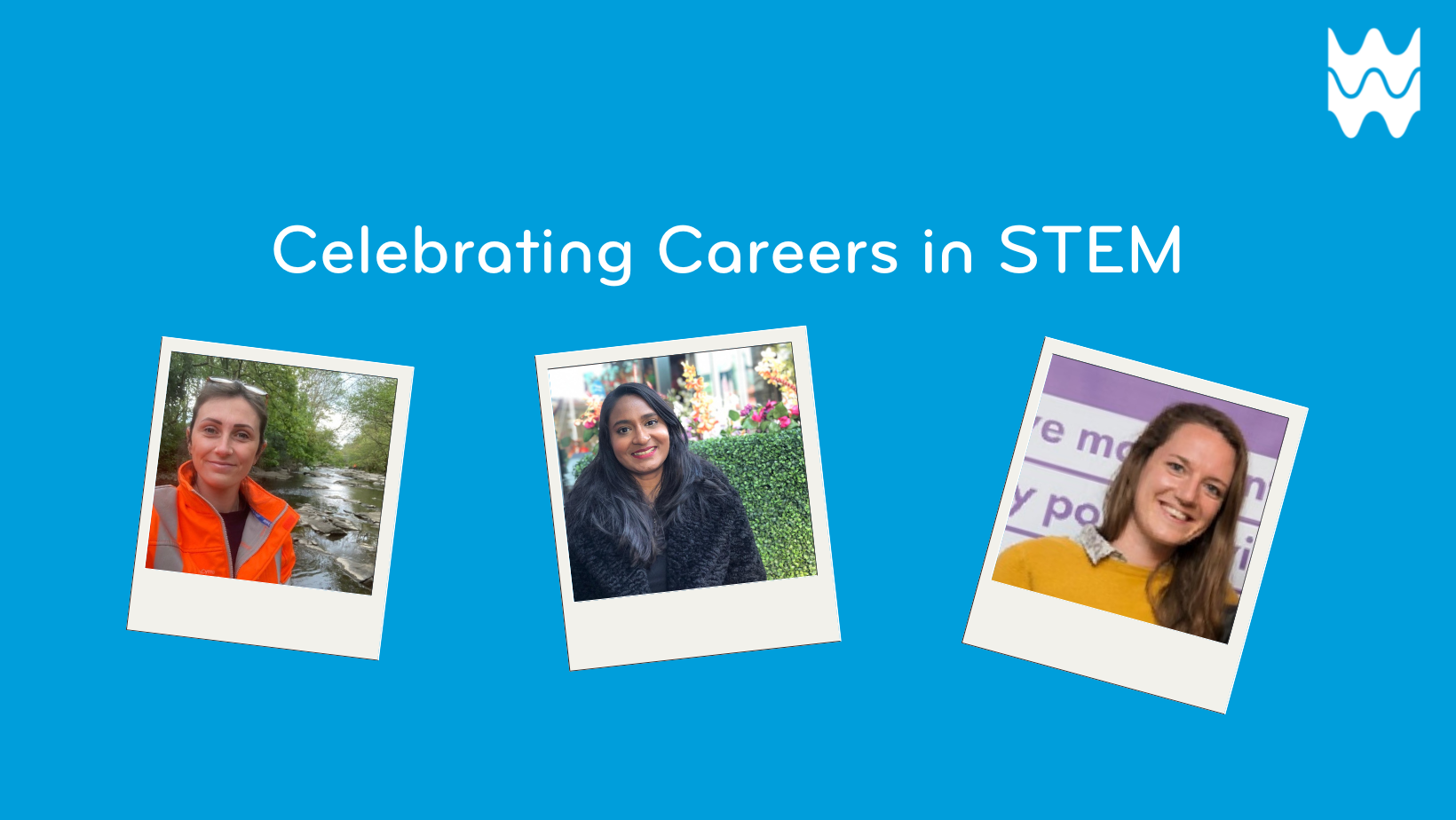
Here at Welsh Water, there are a huge number of colleagues who work in STEM fields every single day. We’ve caught up with three – Willow, Kelly and Bevita – who tell us a bit more about their roles.
Who are you and what’s your role at Welsh Water?
“I’m Willow Smallbone, Data & Analytics Manager at Welsh Water. I lead the Data Science Team to deliver analytical projects that provide Welsh Water with decision support tools that help the business to make more informed data led decisions.”
“My name is Kelly Jordan and I’m a River Quality Liaison Manager for West Wales. My role involves working with many different colleagues across Welsh Water to help with any queries we get from the public. I help explain the science and engineering of our operations to anyone with river quality interest. This can include treatment works processes, water quality and network structure. Before that, I’ve worked in various roles involving biology.”
“I’m Bevita Mattu, a Mechanical Engineer covering South Wales and Hereford region. This involves designing mechanical elements (i.e. pipework, tanks, pumps, access etc) for our pumping stations, water treatment works and wastewater treatment works, to make sure water gets to all our customers and leaves properly, and ensuring our operational colleagues can safety treat it. A snippet of what this can involve are site visits, calculations, drawings, environmental surveys, report writing and working in teams to get the right solutions.”
How did you first become interested in STEM subjects?
Willow: “Since a young age, I’ve always been that person to ask “why?”, so I can learn more. Through my teenage years this led me to a work experience placement with a vet. His passion and interest in parasitology (the study of parasites and parasitic diseases) was passed across to me, leading to me studying Zoology and subsequently a PhD involving parasitology. I continue to be someone that enjoys problem solving and asking why and I feel a career in STEM really supports me continue to do this.”
Kelly: “I’ve always had an interest in science. My biology teacher was very encouraging and made lessons fun and interactive. It was never a direct plan to work in a STEM industry, it just felt like a natural pathway based on what I enjoyed learning.”
Bevita: “Early on in secondary school I really wanted to know how the world worked around me and became fascinated by atoms, subatomic particles, and how they make up everything around us and beyond. I decided to study Physics and Astrophysics at university, then I decided I wanted to put this into practice as an engineer.”
What has been your biggest achievement in work to date?
Willow: “I’m committed to asking why and always look with curiosity at data and its potential for solving challenges and this has manifested itself into several important products that have had benefit to the business. Not necessarily my biggest achievement but something that fills me with joy: working with colleagues on my team to develop and learn. Nothing makes me happier than seeing them build their confidence, skills, and knowledge. I love to see the team succeed whether that be through project delivery or personal achievement.
Bevita: “Designing a temporary syphon to supply our water treatment works in mid Wales and seeing this onsite and in action. This provided a supply equivalent to that needed for 34,500 people a day, at maximum demand (based on the average amount of water a person uses a day). I am also immensely proud to have worked on progressing racial and gender diversity within my industry.”
What advice would you give to young people who are interested in STEM subjects?
Willow: “STEM is an exciting and ever developing field. Keep developing yourself and learning so that you can stay at the forefront of knowledge but most importantly, never stop asking why. This will help you to learn but also help you to problem solve to get to a solution.”
Kelly: “STEM can lead to such a wide range of careers. Do what you enjoy, and you’ll be surprised the opportunities you can find. My colleagues bring such a wealth of knowledge and experience, that I constantly learn from.”
Bevita: “If you are interested and enjoy it, pursue it, even if you don’t have a master plan for where you might end up as a career. Having that interest and enthusiasm means you will put more effort into it and therefore the outcomes will be better. There are so many transferable skills within the sciences, and it is for absolutely anyone and everyone that wants to pursue it.”
One of this year’s themes is #SmashingStereotypes. Do you have any examples of how working with more diverse colleagues has led to success?
Willow: “Diversity is so important for any team. For Data Science a diverse team will support broader ideas for problem solving, reduce bias in solutions and support out of the box thinking. I am proud to work with colleagues from diverse backgrounds, observe them collaboratively working and learning from one another and seeing them succeed as a team.”
Kelly: “My previous role as a project manager involved sitting on multiple steering groups. These groups included a wide range of individuals and experience which helped identify problems and develop innovative solutions. Different representatives, points of view and knowledge around the table can only benefit our STEM challenges.”
Bevita: “I created and hosted an event to openly discuss racial diversity within the water industry, where I was joined on a panel by 5 black female colleagues. This was attended by over 150 people and the video viewed more than 600 times on YouTube. This has grown into more events of its kind and stretched to other parts of the UK. The initial idea has led to impactful changes and open conversations.”
Finally, what are your hopes for the future?
Willow: “I hope that we find a way to encourage young people into STEM subjects from backgrounds that are currently underrepresented across STEM. I hope we can support these individuals to develop themselves and provide an environment that allows them to flourish in order to make STEM a lifelong career, where they are able to be themselves and be appreciated for all that they contribute to their field.
“Throughout my career, I hope that I can inspire others to see how exciting and unique STEM roles are and be a mentor to those starting out on their journey.”
Bevita: “I hope to always enjoy what I do for my career and to see great diversity in the workforce. I hope young people can see themselves represented, to know and believe they can also do it!”
 General content