Your unmetered bill
If you do not have a water meter, you will be charged a fixed cost each year based on your property.
Your 2026/27 BillFrequently asked questions about your bill
The average Dŵr Cymru Welsh Water household customer bill will increase by 4.8% in 2026-27, from £652 to £683.
Customers with a water meter will see their bills go up by around 6.2%, while unmeasured customers will see a rise of around 9.7%.
The average amount is the increase across our entire customer base taking into account - metered, unmeasured and social tariffs.
How much an individual customer’s bill changes can vary depending on things like whether they are a household or business, whether they have a meter, and whether they receive water, wastewater, or both services.
For most customers, the biggest difference comes down to whether they are metered or unmetered. Customers who use a meter often save money by paying only for the water they use.
Even with this year’s changes, our increase remains among the lowest compared with other water and wastewater companies across Wales and England in recent years. After last year’s larger rise, we’re focused on balancing the investment needed to improve services with keeping bills as affordable as possible.
We don’t set our prices ourselves. Ofwat, the independent regulator for the water industry, decides the price limits we must follow.
Every five years, we agree with Ofwat how much we will invest to make improvements to our services.
Between 2025 and 2030, Welsh Water will be investing over £4 billion to improve our services — including £2.5 billion specifically to protect and improve the environment.
This essential investment will help us:
- reduce pollution
- upgrade and build important new infrastructure
- tackle leakage
- improve water quality
- and continue improving our overall performance as a company
We understand that any price increase can be a challenge and that’s why we always work to keep them as low as possible. However, over the past 15 years, bill increases have not kept pace with inflation, which means we now need to invest more to maintain and improve the services our customers rely on.
There are several reasons why neighbouring properties may have different charges. For example, one home may be on a water meter while another may be on an assessed charge, or their rateable values may differ if neither is metered.
As every household’s billing setup is unique, we can’t confirm the exact reason without reviewing each account — and we’re not able to share any details about another customer’s bills.
Unlike energy companies, we don’t set our own prices. Our charges are set by our industry regulator, Ofwat. We have to clearly show them what investment is needed to improve our services, and they then decide what prices we’re allowed to charge.
Energy companies work differently. They set their own prices, which can change based on several factors such as the wholesale cost of energy, the need to invest in new infrastructure, and the development of renewable technologies.
We understand that the current economic climate is difficult for many of our customers. To help, we offer a range of tariffs designed to support people who are struggling to pay their bills. We’re currently helping almost 142,000 customers through these social tariffs.
We have a number of options available to support customers who are struggling.
- Water Meters – We can arrange to fit a meter free of charge. Depending on the usage, customers may benefit from being billed for what they use.
- Water Efficiency – If you’re on a water meter, we may be able to offer free advice to help you reduce the water you use.
- 12 monthly Direct Debits – Sometimes, spreading payments out until next March instead of next January can make quite a difference to the monthly payment amount.
- Affordability options – Depending on your circumstances, we might be able to offer extra support through one of our affordability schemes.
We provide a simple online application process for our customers to apply for a water meter.
We first encourage our customers to use our online calculator to see if a meter could save you money.
You can then submit a water‑meter application directly online using the form provided.
You can check your water usage and apply for a water meter via this link.
What do I pay for?
Unmeasured bills are sent once a year and take one of three formats, either:
Rateable value (RV) charge - the bill will be made up of a standing charge plus a charge per pound (£) of rateable value for the property.
or
Uniform Service Charge (for properties built between 1 April 1990 and 31 March 2000) - charges are based on the average rateable value of properties in Wales.
or
Assessed measured charge - If you have applied for a water meter but have been unable to have one fitted, you may be entitled to go on an assessed measured charge. Our household Assessed Measured Charges can be found here.

Rateable value
The rate was set by the valuation office, and it's based on things like your property value and if your house was built before 1990. The rates were frozen in 1990 with council tax being introduced and have stayed the same since.
How much do I pay?
You can view our 2026-2027 charges to see how much you will be charged.
How to know when your bill is due or available?
We will send your unmeasured bill once a year by the end of March for charges from 1st April to the following 31st March (like your council tax bill).
When a bill is produced, it will be sent to you in the post if you are not signed up to our online My Account service.
If you are signed up to My Account then an email will be sent to you to let you know that a new bill is available. You’ll then need to log in to My Account to view your latest bill.
What happens when you get your bill?
Your bill has to be paid in 14 days of receiving it unless you have a Direct Debit or payment plan in place. If you pay your bill in full by 1st April, you will get a 1.5% discount off your charge.

Help with your bills
We have a number of ways we may be able to help make your bills more affordable.
Learn more about ways to reduce your current bills
Help with your bills
We have a number of ways we may be able to help make your bills more affordable.
Learn more about ways to reduce your current billsAre you a water-only customer?
| Occupancy | Water | Service charge | Annual |
|---|---|---|---|
| 1 | £101.54 | £58.63 | £160.17 |
| 2 | £203.08 | £58.63 | £261.71 |
| 3 | £304.62 | £58.63 | £363.25 |
| 4 | £406.16 | £58.63 | £464.79 |
| 5 | £507.70 | £58.63 | £566.33 |
| 6 | £609.24 | £58.63 | £667.87 |
| 7 | £769.41 | £58.63 | £870.95 |
| 8 | £812.32 | £58.63 | £870.95 |
| 9 | £913.86 | £58.63 | £972.49 |
| 10 | £1,015.40 | £58.63 | £1,074.03 |
Depending on how often you pay your bill, we would expect this to break down to...
| Occupancy | Annual | 6 Monthly | Monthly | Weekly |
|---|---|---|---|---|
| 1 | £160.17 | £80.09 | £13.35 | £3.08 |
| 2 | £261.71 | £130.86 | £21.81 | £5.03 |
| 3 | £363.25 | £181.63 | £30.27 | £6.99 |
| 4 | £464.79 | £232.40 | £38.73 | £8.94 |
| 5 | £566.33 | £283.17 | £47.19 | £10.89 |
| 6 | £667.87 | £333.94 | £55.66 | £12.84 |
| 7 | £769.41 | £384.71 | £64.12 | £14.80 |
| 8 | £870.95 | £435.48 | £72.58 | £16.75 |
| 9 | £972.49 | £486.25 | £81.04 | £18.70 |
| 10 | £1,074.03 | £537.02 | £89.50 | £20.65 |
Your 2026/27 BillMore frequently asked questions about your bill
Unmeasured customers are billed based on rateable value or uniform service charges, not on how much water they actually use. These charges are fixed and cannot respond to real consumption patterns, meaning unmeasured charges rise as a block, rather than spreading increases based on usage.
Metered customers, by contrast, can offset some of the increase through lower consumption.
Unmeasured charges will apply if a property was built before 1 April 2000, has not been redeveloped, has not had a change of use, is not subject to compulsory metering or is not either currently metered or subject to a metered charge (assessed or otherwise).
The charge will not reflect how much water is used. There are two ways to calculate unmeasured charges:
Rateable value charge — a service charge that is calculated by the Valuation Office Agency (VOA), plus a charge per pound of rateable value for water and sewerage services.
OR
Uniform service charge (for properties built between 1 April 1990 and 31 March 2000) – charges are based on the average rateable value of properties in Wales.
Water charges cover the costs of providing water to the property. Sewerage charges cover the cost of removing, treating and disposing of the used water including a charge for surface water and highway drainage. This includes the cost of draining, treating and disposing of rainwater. If none of your rainwater drains to the public sewer, then you will be exempt from this element of your charges. A Surface Water Rebate form can be found on our website here or can be requested by calling us on 0800 052 0145. Any rebate will be affected from 1st April 2020 or the date of occupation if later. Where it is evident that surface water does not return to the sewer, typically flats in a common building, the company may proactively notify customers and adjust their charges accordingly.
Unmeasured bills are normally sent out in February/March each year and are payable on 1 April, unless an alternative payment arrangement has been made with Dŵr Cymru Welsh Water.
No- RVs were fixed prior to 2000 and there is no basis to challenge or change them now, the standard position would be if the customer feels their RV is too high, they should switch to a meter.
If any significant alterations have been made to the property such as splitting the property this would require a meter to be installed so that the property can be billed accurately.
In order to support our largest-ever investment plans for AMP8, where we plan to invest £4 billion into our services between 2025–2030. A 68% increase compared to our AMP7 investments (2020-2025), increasing our bills further over the next few years is a possibility.
Bill increases are essential to ensure we provide the communities we serve with reliable, world class water services. Our AMP8 plans will allow us to invest significantly in our infrastructure, addressing ageing assets, and meeting rising regulatory and environmental standards. These investments are crucial for maintaining service levels, reducing the risk of supply interruptions, and supporting our communities.
However, unlike other water and wastewater companies we implemented our largest bill increase last year (2025-26), meaning any bill increases to follow will be significantly less than other companies across Wales and England.
Where water and sewerage services are provided by different companies, the company supplying the water is responsible for sending the bill and collecting payment for both water and sewerage.
So, if you're water‑only with Welsh Water, Welsh Water will also issue and collect your sewerage charges on behalf of Hafren Dyfrdwy, and Hafren Dyfrdwy set the waste charges you see on your bill. You don’t need to contact your sewerage provider separately for routine billing.
For measured customers the water company is responsible for taking the meter reading, and this is used to calculate both the water bill and the wastewater bill. The wastewater bill is calculated assuming 95% of water that is delivered to the property is returned to the sewer.
The decision over how our Executive Team salaries are determined is decided by an independent panel of non-executive directors, who can decide what is appropriate. It is then approved by independent “Members” – whose job it is to scrutinise the work of Welsh Water in the same way shareholders do in listed companies. The priority throughout this process is to ensure that remuneration is reasonable, fair and competitive and helps us attract and retain high calibre employees – without ever being excessive – and is dependent on performance that benefits our customers.
It is also important to note that Welsh Water’s Chief Executive is amongst the lowest-paid of all Chief Executives of water companies in Wales and England.
The focus of everybody that works for Welsh Water is to ensure we offer customers the highest-quality service at the lowest-possible price.
Our not-for-profit status means we exist to invest in, and benefit, our customers. We believe it’s a better way of working and ensures any “profit” we make is reinvested back into the business, rather than to benefit shareholders like in other businesses.
However, we own a big network of sewers – 36,000km (enough to stretch to Australia and back) – and drinking water network, so we have to charge for supplying water and wastewater services to make sure we can invest to provide the best-quality services we can.
We make every effort to provide the best-quality services at the lowest possible cost. We appreciate that this increase is higher than seen in previous years but for more than a decade we managed to keep the price rises below the RPI measure of inflation.
The Cymuned Scheme is specifically designed for our working customers who are struggling financially, it can help provide some relief for customers whose household bills are higher than their income.
The scheme could help to support customers short term by giving them a three month ‘charge free’ period (it works out at around £120 of their annual bill).
Those who apply will need to have their financial situation assessed through an Income and Expenditure assessment which is completed by trusted organisations, such as Citizens Advice.
If the customer would like further information about Cymuned, please speak to the Specialist Support Team.
As a not-for-profit company it means we don’t have any shareholders. The good thing about this is that we can re-invest the profit we make into improving the services we offer to our customers while keeping bills as low as possible.
Customers can be assured that the money we receive through the bill will go towards improving service and accelerating schemes which will protect our environment now and in the future.
We operate around 27,500km of water mains and over 36,000km of wastewater pipes therefore ensuring these provide our customers with the first-class service they expect requires investment. Examples of ways we are already improving services include building new water treatment works, replacing old water mains and upgrading wastewater treatment processes. We are also investing in generating renewable energy at our sites. As well as reducing our carbon footprint, this reduces our operating costs which helps keep customer bills down.
Our priorities when determining how much we charge our customers are always:
- How we can keep bills as low as possible for all customers
- How we support those on the lowest incomes who are genuinely struggling to pay their bills
- How we can accelerate investment in our network to benefit our customers
For more information on our plans and investment from 2025-2030 please visit here.
We know that we are not the cheapest water and sewerage company in the UK. The reason for this is because much of our operating area is predominantly rural, therefore a lot of network is required to ensure we reach the remotest of areas. Operating and maintaining such a network is costly – more costly than it would be in a densely populated area.
As a company, we always try to do our bit and being not-for-profit means that we can reinvest the profit we make back to our customers. For example, from 2020-25 we spent £60m on making sure that we were providing financial support to customers struggling to pay their bills.
We are now supporting almost 142,000 customers with our range of social tariffs and expect this figure to grow in the next year.
Our priorities when determining how much we charge our customers are always:
- How we can keep bills as low as possible for all customers
- How we support those on the lowest incomes who are genuinely struggling to pay their bills
- How we can accelerate investment in our network to benefit our customers
Revenue allowances are set separately by Ofwat for water services and waste services, so these translate into different bill levels for each service.
For customers who are only supplied for water or waste services by DCWW the other service will be delivered by a different company, who will be set different revenue allowances and calculate their own charges separately from ours. This means that the bill levels will be different compared to a customer receiving both services from us.
As a not-for-profit company, we put our customers at the heart of everything we do. That’s why we’ve placed such importance on supporting those that need help the most. We already support almost 142,000 customers with one of our social tariff schemes to help pay their bills, but we know that there are more that need our help.
We contribute £14 million a year to maintain our social tariffs schemes.
While some of the money customers pay us does go towards supporting our most vulnerable customers, we also contribute and are one of the few who invest from our own profits to support our lowest-earning customers.
We would add that it also benefits all our customers if we can make it easier for our lowest-earning customers to commit to manageable payments. The alternative is that they don’t pay anything at all and this already adds around £20 to the bills of paying customers.
The way the water industry is run and regulated is a matter for government, not for us, and it wouldn’t be appropriate for us to comment on these debates.
However, as a not-for-profit company our sole focus is providing the best-possible service for customers at the lowest-possible price. We believe our Customer-led Success way of working ensures that our customers are at the forefront of how we work and ensures they get value for money.

Investments in your area
Welsh Water plans to invest £4 billion over the next 5 years (2025-2030), a 68% increase compared to the previous 5 years. This investment includes a record £2.5 billion dedicated to protecting and improving the environment. The investment plan also focuses on improving drinking water compliance and reducing customer complaints about water quality.
Enter your postcode to find out what is happening in your area.
{{postcode}} We've not matched your postcode - Investments in your area

More about your bill

Setup a Direct Debit or amend your bank details
If you're struggling to pay your bill in full, spread the cost by paying weekly, monthly or 6 monthly, either by direct debit or a payment card.

Our charges
View and download our latest scheme of charges.

Switch to a water meter
You might save money by having a water meter installed.
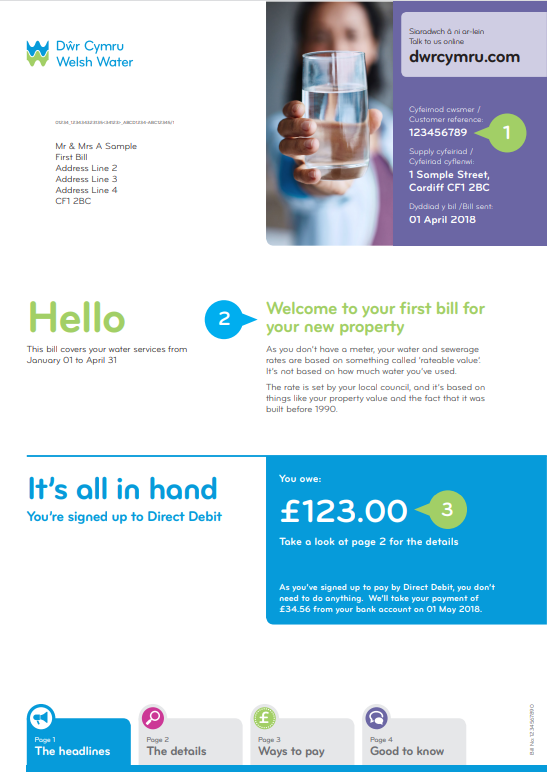
A breakdown of your bill
Page 1: A summary
- Your customer reference number - You’ll need to give this to us if you contact us with any questions about your bill or if you want to pay your bill.
- The headlines - This tells you the reason for the bill and what rates your bill is based on.
- The bill amount - This tells you how much you owe and if you need to take any action.
- Your charges - This shows how we’ve worked out your bill.
- Your payment plan - If you’ve already set up a payment plan with us, this section details what you’ll be paying and when.
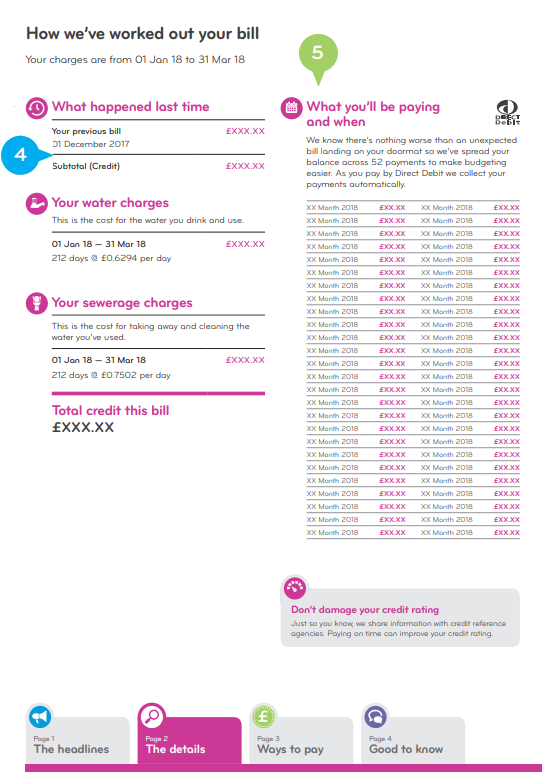
Page 2: The details
If you see ‘charges we’ve removed’ this is where charges have been cancelled from previous bills.
If you opted for a meter but we’ve been unable to fit one for some reason you may see ‘household assessed measured charge’ on your bill. This charge is based on the information you gave us about your water usage when you enquired about a meter. The charge will be applied from the date the meter would have been fitted.